Why Server-Side Tracking Is Still Relevant, Despite Google's Decision on Third-Party Cookies
 Matthijs BoonFounder and online marketer
24 July 2024
Google recently announced that it's abandoning the phase-out of third-party cookies in Chrome, through the “Cookie3Dless” mode that Chrome users can activate.
Instead, the company is introducing alternative methods through the Privacy Sandbox to safeguard users' online privacy.
While this news might be a reason for some to postpone server-side tracking, I remain convinced that implementing it matters a great deal for modern digital marketing. Let me explain why.
In Short
- Google is keeping third-party cookies, but server-side tracking remains vital
- Six key benefits of server-side tracking are highlighted
- Benefits include improved privacy, data quality and website performance
- Server-side tracking is key for future-proof online marketing
- Why businesses need to invest in this technology now
First-Party Cookies Remain King
Despite Google's recent decision to keep third-party cookies in Chrome, the reality is that other major browsers have already taken steps to protect their users' privacy.
Safari, with its Intelligent Tracking Prevention (ITP), and Mozilla Firefox, with Enhanced Tracking Protection (ETP), block third-party cookies by default.
Together, these browsers represent more than a quarter of the market, to be precise, just over 26%.
This means that for a substantial share of your website visitors, third-party tracking simply doesn't work.
As a result, you miss out on vital data about the behaviour, preferences and conversions of these users on your website.
Server-side tracking offers a solution here.
The great thing is that with clients, we collect up to 30% more data with a server-side set-up compared to a client-side set-up. See the image below from one of our clients.
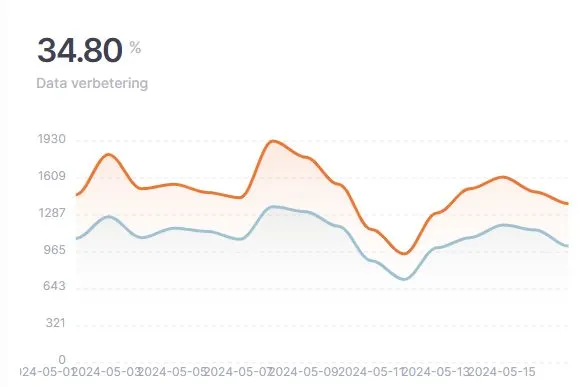
By switching to this kind of tracking set-up, you can rely entirely on first-party cookies.
These aren't blocked by Safari and Firefox, which means you can collect data from all your visitors, regardless of which browser they use.
On top of that, using first-party cookies through server-side tracking offers a number of additional benefits:
- A longer cookie lifespan in some browsers
- Better control over the data you collect
- Increased accuracy in your analytics

Getting Around Ad Blockers
The use of ad blockers has grown explosively in recent years.
Many of these tools specifically target the blocking of client-side scripts, which are traditionally used for tracking and advertising purposes.
This can result in a significant loss of valuable data on your visitors' behaviour.
Server-side tracking offers an effective way to get around a large part of this challenge.
Because the tracking happens on the server rather than in the user's browser, these data flows are largely invisible to ad blockers.
This lets you still collect a significant share of data that would otherwise have been lost.
The importance of this can hardly be overstated:
- More accurate analytics: With more complete datasets, you can gain better insight into your visitors' behaviour.
- Improved campaign performance: With more complete tracking, you can optimise your marketing campaigns more precisely.
- More reliable attribution: With more data, you can better understand which channels and actions actually lead to conversions.
- Optimised user experience: With better insight into user behaviour, you can further improve your website and services.
It's worth noting that server-side tracking can't get around every effect of ad blockers, but it can recover a significant share of data that would otherwise be lost.
This makes it an indispensable part of a modern, resilient tracking strategy that's built to last.
Increased Data Quality and Control
Server-side tracking offers an unprecedented level of control over your data.
Unlike client-side tracking, where data is sent straight from the browser to various platforms, server-side tracking acts as a central hub for all your data.
This brings a number of benefits:
- Data enrichment: You can enrich data with information from other sources before it's forwarded to your analytics tools.
- Data cleaning: Errors or inconsistencies can be corrected before the data is used for analysis.
- Data structuring: You can restructure data so it fits your analysis methods and reporting needs perfectly.
- Data reduction: Irrelevant or unnecessary data can be filtered out, leading to more efficient analysis.
This increased control results in significantly better data quality. Better data, in turn, leads to more accurate insights, which matters a great deal for effective decision-making in digital marketing.
Better GDPR Compliance
In today's privacy-conscious climate, GDPR compliance isn't a luxury, it's a necessity. Server-side tracking offers significant benefits here:
- Data management: You have full control over which data is collected and forwarded.
- Anonymisation: Sensitive information such as IP addresses can be anonymised before it's shared with third parties.
- Data minimisation: You can make sure only necessary data is collected and stored.
- Consent management: It's easier to respect users' preferences around data collection (though this does require a good cookie banner).
These options make it much easier to stay compliant with the GDPR and other privacy legislation, which not only reduces legal risk but also strengthens your users' trust.

Extended Cookie Lifespan
The limited lifespan of cookies in certain browsers, such as Safari's 24-hour limit for first-party cookies, can pose a challenge for effective tracking. Server-side tracking, combined with techniques such as Cookie Recovery from TAGGRS, offers a solution:
- A longer tracking period: By extending the lifespan of cookies, you can follow user behaviour over a longer period.
- Improved cross-device tracking: It lets you better track users across different devices and sessions.
- More accurate attribution: With longer tracking periods, you can better attribute conversions to specific marketing actions.
It matters a great deal to stress that this extended tracking may only be applied with the user's explicit consent, in line with privacy legislation.
So you'll need a proper cookie banner on your website that can then be linked to your tracking set-up. This is also known as Consent Mode V2 (this has been mandatory since the end of March 2024 if you run Google Ads campaigns.)
Improved Website Performance
Server-side tracking can have a significant impact on your website's loading time and overall performance:
- Fewer client-side scripts: By moving tracking code to the server, you reduce the amount of JavaScript that needs to run in the browser.
- Faster loading times: This results in faster loading times, which matters a great deal for both user experience and SEO.
- Improved user experience: Faster websites lead to higher engagement and conversion rates.
From personal experience with implementations, I can say that the website feels noticeably faster after implementation.
This underlines not just the technical benefits, but also the practical impact on your digital marketing efforts.
These improved performance gains, combined with the benefits mentioned earlier, make server-side tracking a powerful, versatile solution for modern digital marketing challenges.
Conclusion
While Google's decision on third-party cookies might reduce the urgency for some, the benefits of server-side tracking still stand.
From improved data quality and privacy protection to better website performance, the case for implementing it is stronger than ever.
On top of that, you can assume that some Chrome users will turn on the Cookie3Dless mode.
Without server-side tracking, you'll lose the data from that group regardless.
So…
When will you start implementing server-side tracking?