Is SEO Really a Passive Gold Mine, or a Myth Online Marketers Won’t Tell You About?
 Matthijs BoonFounder and online marketer
31 January 2024 · updated 17 January 2024
Imagine sitting comfortably at your desk, scrolling through the growing numbers of your website visitors and sales, all while enjoying your morning coffee.
This is not fantasy, but the reality for those who’ve unravelled the secrets of SEO, or maybe it is fantasy after all, and this is more of a picture that does well on social media?
I’m Matthijs, and in this article I’ll walk you through what’s actually passive about SEO, and what isn’t.
My experience as an SEO specialist at large marketing agencies, plus running SEO experiments on my own websites, has given me a lot of insights that I’ll share with you here.
This way, you’ll be armed straight away with the knowledge I’ve picked up over the past few years.
In Short
- SEO does have a compound effect and is, in a certain way, passive.
- SEO does require an initial investment of time and money, and if you want to do it properly, an ongoing investment to keep your website up to date.
- Take a close look at what the ROI of SEO actually is.
- Strong SEO results stick around, unlike paid ads, which stop the moment you stop paying.
- SEO is an investment that can generate passive income in the long run, but requires ongoing effort to keep performing.
The Basics of SEO
Let’s first dive into what SEO actually is. SEO, or search engine optimisation, is the process of setting up your website so it’s easier to find in search engines like Google and Bing.
But is SEO passive? Well, the answer isn’t black and white. SEO requires effort and expertise at first.
But once it’s properly set up, it can provide a steady stream of organic traffic without daily manual effort. Want to know more? Read my detailed explanation of what SEO is.
How does SEO work in practice? It’s about optimising your website and content for relevant keywords, so you rank higher in the search results.
This means improving technical aspects, creating quality content, and building a strong link structure.
The importance of SEO for online visibility and growth is undeniable. Did you know that most online experiences start with a search engine?
SEO helps you rank at the top of these search results, so potential customers visit your website before your competitor’s.

SEO as a Passive Income Source or Lead Generation Machine
Now, on to passive income through SEO. If your SEO strategy is solid, it can generate organic traffic while you sleep, exercise, or enjoy your holiday.
This is what we mean by passive.
You invest time and resources upfront, but afterwards you reap the rewards without constant effort.
Let me give you some examples of how SEO can lead to passive income in the long run.
Imagine this: your article about ‘the best running shoes’ ranks number one on Google. Months, even years, after publishing, it’s still attracting visitors who buy running shoes through your affiliate links.
That’s long-term income without you having to check on it every day.
Finally, a word on the durability of organic search results. Unlike paid ads, which stop the moment you stop paying, strong SEO results stick around. This provides a lasting, reliable source of traffic and income.
Curious about the latest SEO trends that could affect your passive income? Check out my article on this year’s SEO trends.
The Reality of SEO Work
Let’s dive into the core of SEO. It’s time to lift the veil on the real effort SEO requires and the results it can deliver.
SEO and Long-Term Results
SEO isn’t a sprint, it’s a marathon. Long-term results require consistency and patience.
Looking back on my own experience as a freelance SEO specialist, I see a clear pattern: websites that consistently invest attention in SEO, such as regular content updates and technical SEO optimisations, end up reaping the biggest and fastest rewards.
This means more traffic, higher rankings and ultimately more revenue and/or leads.
I also have examples where, for a client, I mainly focused on getting the basics right, both on the technical side and in terms of content and structure, and that client kept growing steadily for a long time afterwards.
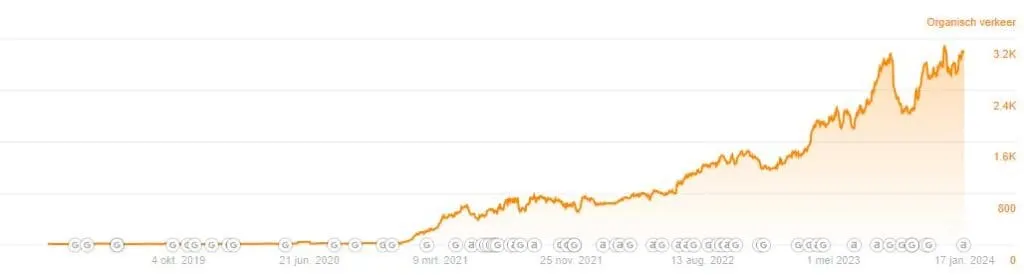
Below is an example of an online store I worked on to get the basics right.
This website had zero organic traffic for years before we started. We began working on it at the end of 2020 and managed to achieve solid growth with a very limited budget.
After the project ended, the website still kept growing nicely. It was a small project with a very limited budget. But still a great long-term result, as you can see.
Not much has been done on the SEO side for this one over the past 1.5 years. Just imagine what it could have been if we’d kept working on it properly?
The Myth and Reality of SEO Investment vs. Return
Here’s the deal: SEO requires an investment, both in time and money. But, and this is a big but, the ROI (return on investment) of SEO can be extraordinarily high.
Why? Because well-executed SEO delivers lasting results, even after the initial investment has been made.
Think of a well-ranked blog post that keeps generating traffic and leads months, or even years, after publication.
Example:
You put 8 hours into a really good, in-depth blog post (like this one, haha). After a couple of months, it ranks nicely in the top 10 and generates revenue or leads for months on end.
Those 8 hours might seem like a lot at the time of writing, but if you generate dozens of leads from it, an 8-hour investment turns out to be not that much after all.
The Need for SEO Maintenance and Management
SEO is generally not something you set up once and then forget about, if you want the best results.
It requires ongoing maintenance and management, as well as continuing to build out your website.
Google’s algorithms keep changing, and your SEO strategy needs to move with them.
Regular analysis, updates and adjustments really matter for holding on to those top positions in the search engines.
Things to Keep in Mind When Determining the ROI of SEO
If you’re considering investing in SEO, it really matters to understand what the return on investment (ROI) of SEO can be. However, there are a few key factors that can affect the effectiveness of your SEO efforts:
Algorithm Updates
Search engines like Google regularly change their algorithms. What works today might be outdated tomorrow.
To be completely transparent. I currently have one of my own websites where traffic unfortunately dropped dramatically after a series of algorithm updates. See below.

As you can see, we’ve been hit by Google updates before, and we’ve found our way back every time. So I’m fully confident we’ll find a way to bounce back from this one too.
This underlines how much it matters to stay up to date with SEO trends and practices. Tip: stay on top of the latest SEO developments through our newsletter.
You’re Not Guaranteed Good Rankings
SEO isn’t an exact science. Even with best practices, there’s no guarantee you’ll reach the top of the search results.
It requires ongoing effort, strategic planning and adjustment.
At Digital Bean, we help you with a strategic approach to boost your chances of success. Get in touch for professional SEO help.
Competition Also Plays a Role
Remember, you’re not the only one trying to reach the top of the search results. Competition can be fierce, especially in popular niches. This means you need to keep innovating and refining your strategies.
SEO and Conversion Optimisation
SEO isn’t just about generating traffic; it’s also about conversion. It’s not enough to attract visitors to your site; you need to turn them into customers or leads.
Tips for Writing SEO- and Conversion-Optimised Content:
- Know Your Audience: Understand who your target audience is and what their needs and pain points are. This helps you create relevant, engaging content.
- Use Appealing Titles and Meta Descriptions: These are the first things a user sees in the search results. Make them intriguing and relevant.
- Focus on Quality Content: Write content that adds value. This builds trust and drives engagement.
- Use Calls to Action (CTAs): Encourage your readers to take action, whether that’s getting in touch, signing up for a newsletter, or buying a product.
- Optimise for Search Intent: Make sure your content matches what your audience is searching for. This doesn’t just boost your SEO rankings, it also increases the chance of conversions.
- Test and Optimise: Use A/B testing to see what works best and keep refining your strategies.
Remember, SEO and conversion optimisation go hand in hand. At Digital Bean, we aim not just to boost your visibility in search engines, but to make sure that traffic actually converts too.
Calculating the ROI of SEO
To calculate the ROI of SEO, I want to walk you through an example to make it more concrete.
Starting Situation:
- An online store had an average monthly organic traffic of 5,000 visitors.
- The average order value (AOV) was €50.
- The website’s conversion rate was 2%.
SEO Implementation:
- Over the course of a year, investment went into SEO, focused on content creation, on-page optimisation, and link building.
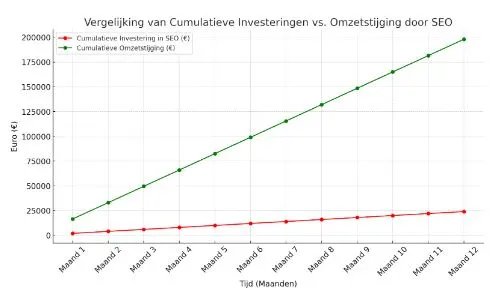
- Total cost of the SEO campaign for one year: €24,000.
Results After 1 Year:
- Monthly organic traffic rose to 15,000 visitors (a 300% increase).
- The conversion rate improved to 2.5%.
- The average order value stayed constant at €50.
Calculating the ROI:
- Increase in Monthly Revenue:
- Original monthly revenue = 5,000 visitors x 2% conversion rate x €50 AOV = €5,000.
- New monthly revenue = 15,000 visitors x 2.5% conversion rate x €50 AOV = €18,750.
- Increase = €18,750 – €5,000 = €13,750 per month.
- Annual Increase in Revenue:
- €13,750 extra per month x 12 months = €165,000 extra per year.
- ROI Calculation:
- Annual ROI = (Profit – Cost) / Cost x 100.
- Annual ROI = (€165,000 – €24,000) / €24,000 x 100 = 587.5%.
Conclusion:
In this example, a year of investing in SEO delivered an impressive annual ROI of 587.5%. This shows the potential of SEO as a powerful investment for online growth, where the initial costs are more than made up for by the increased revenue.
And that’s just a calculation for 1 year. Just imagine what the ROI looks like after 3 or 4 years.
Conclusion: Is SEO Passive or Not?
And now, the answer to the big question. Is SEO passive or not?
Well, SEO is an investment, but it can keep delivering (in a passive way) for a long time. Of course, you do need to rank well for that.
To keep ranking, or to start ranking for even more search terms, you’ll need to keep investing. It does have a kind of compound effect, though, since the work you’ve already put in keeps paying off while you move on to working on something new.
So it’s really about figuring out when you have a good ROI.
I hope this article has helped point you in the right direction on the question of whether SEO is passive or not, and in what way.
If you still have any questions, leave a comment below, or get in touch if you’d like to explore how we can get your website to the top of Google.